Table of Contents
- Introduction: Why spironolactone interactions matter
- How spironolactone works (relevance to interactions)
- Major drug interactions: ACE inhibitors, ARBs, and potassium-sparing combinations
- Potassium and hyperkalemia risk — what to watch for
- NSAIDs, renal perfusion, and reduced diuretic effect
- Lithium, digoxin, and narrow therapeutic index drugs
- Cytochrome P450, metabolism issues, and uncommon interactions
- Special populations: elderly, CKD, pregnancy, and heart failure
- Practical monitoring and management strategies
- Top patient tips and quick checklist
Introduction: Why spironolactone interactions matter
For readers comparing diuretic options, buy aldactone without prescription can lead to a product page with usage details, dosage notes, precautions, and ordering information.
Spironolactone interactions are a frequent and clinically important topic because spironolactone is a widely used potassium-sparing diuretic with hormonal effects. It's prescribed for hypertension, heart failure, ascites, and acne in some cases; these indications often involve polypharmacy, increasing the risk of drug interactions. Knowing which combinations raise the risk of hyperkalemia, renal impairment, or altered drug levels is essential for safe prescribing and patient counseling.
How spironolactone works (relevance to interactions)
Spironolactone antagonizes the mineralocorticoid receptor (aldosterone receptor) in the distal nephron, reducing sodium reabsorption and potassium excretion. Because it conserves potassium, any co-administered agent that raises serum potassium or decreases renal potassium excretion magnifies the risk of hyperkalemia. Additionally, spironolactone and its active metabolite, canrenone, have effects beyond the kidney—interacting at hormonal receptors and occasionally affecting drug metabolism indirectly. Understanding this mechanism clarifies why certain classes of drugs create clinically significant spironolactone interactions.
Major drug interactions: ACE inhibitors, ARBs, and potassium-sparing combinations
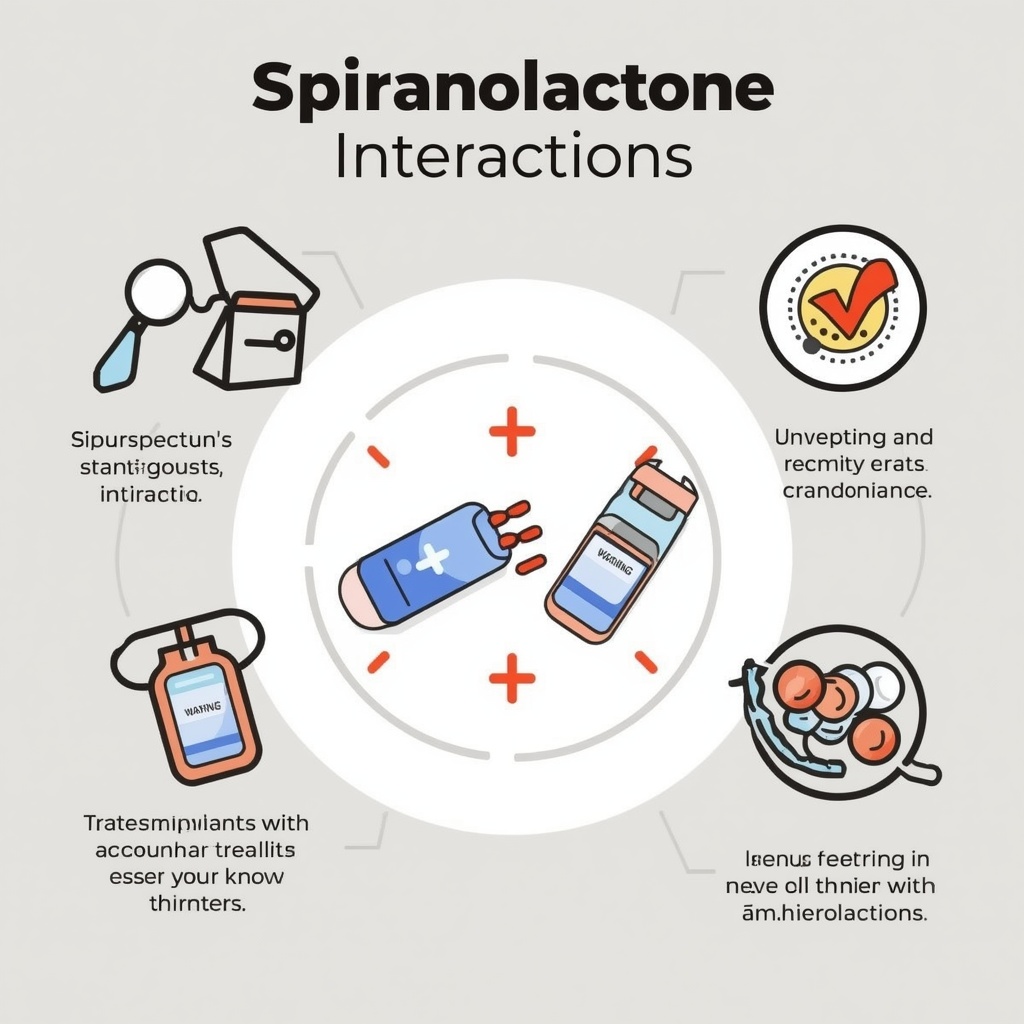
The most clinically dangerous spironolactone interactions involve other agents that increase serum potassium. ACE inhibitors (e.g., lisinopril), angiotensin receptor blockers (ARBs, e.g., losartan), direct renin inhibitors (aliskiren), and other potassium-sparing diuretics (amiloride, triamterene) can all produce additive hyperkalemia when used with spironolactone.
Combine these drugs only with careful monitoring or when benefits outweigh risks (for example, in resistant heart failure). Many guidelines recommend avoiding routine combination with other potassium-sparing drugs and using ACEi/ARB + spironolactone cautiously, especially in patients with reduced kidney function.
Potassium and hyperkalemia risk — what to watch for
Hyperkalemia is the principal safety concern in spironolactone interactions. Risk factors that amplify the interaction include chronic kidney disease (CKD), diabetes, age, high baseline potassium, high-dose spironolactone (>25–50 mg/day in many settings), and concurrent use of the other drug classes listed above.
Signs and lab triggers: 1) Mild hyperkalemia: K+ 5.1–5.9 mmol/L — often asymptomatic but needs medication review. 2) Moderate: K+ 6.0–6.4 mmol/L — consider urgent adjustment, repeat labs. 3) Severe: K+ ≥6.5 mmol/L — treat emergently (IV calcium, insulin/glucose, potassium-binding agents).
NSAIDs, renal perfusion, and reduced diuretic effect
NSAIDs (ibuprofen, naproxen) can blunt spironolactone’s diuretic effect and increase hyperkalemia risk by reducing renal prostaglandin synthesis and renal perfusion. This decreases glomerular filtration and impairs potassium excretion, especially in older adults or those with volume depletion. Patients often take NSAIDs over the counter, so ask explicitly during medication reconciliation.
Lithium, digoxin, and narrow therapeutic index drugs
While spironolactone does not have a direct pharmacokinetic interaction with lithium, it can increase lithium levels indirectly through changes in sodium and renal handling, risking lithium toxicity. Monitor lithium levels and clinical signs if combining therapies.
With digoxin, spironolactone can raise serum digoxin concentrations in some reports and may alter cardiac conduction indirectly via potassium changes. Monitor digoxin levels and heart rhythm if used concurrently.
Cytochrome P450, metabolism issues, and uncommon interactions
Spironolactone itself undergoes hepatic metabolism, but classic CYP-mediated interactions are less prominent than with many other drugs. Still, some agents can alter spironolactone’s levels or effects indirectly. For example, potent CYP inhibitors or inducers might change active metabolite levels in theory, though this is less commonly a primary clinical concern than potassium-related effects.
Other less common interactions to be aware of: - Anticoagulants: coagulopathy risk isn't directly increased, but renal changes can affect drug clearance. - Antihyperglycemics: spironolactone can affect insulin sensitivity slightly; watch for glucose changes in diabetic patients.
Special populations: elderly, CKD, pregnancy, and heart failure
Special populations magnify spironolactone interactions: - Elderly: decreased renal reserve and polypharmacy increase hyperkalemia risk. - CKD: even mild reductions in eGFR raise the risk; dosing and monitoring must be stricter. - Pregnancy: spironolactone is generally avoided in pregnancy due to anti-androgenic effects and limited safety data. - Heart failure: low-dose spironolactone reduces mortality in select HFrEF patients, but these benefits require careful monitoring for hyperkalemia, especially when combined with ACEi/ARB.

Practical monitoring and management strategies
Monitor potassium and renal function at baseline, 3–7 days after starting or changing dose, at 1 month, and periodically thereafter. Frequency increases if combination therapy is present, if eGFR <60 mL/min/1.73 m2, or if baseline potassium is high. Below is a practical monitoring schedule commonly used in clinics.
| Situation | Recommended labs | Timing |
|---|---|---|
| Baseline before starting spironolactone | Serum K+, creatinine/eGFR | Within 1–2 weeks prior |
| After initiation or dose increase | Serum K+, creatinine | 3–7 days, then 1 month |
| Adding ACEi/ARB, NSAID, or potassium supplements | Serum K+, creatinine | 3–7 days, repeat at 1–2 weeks |
| Stable patient with normal labs | Serum K+, creatinine | Every 3–6 months |
Top patient tips and quick checklist
Practical steps help patients avoid harmful spironolactone interactions and stay safe.
- Carry an updated medication list — include OTC drugs, supplements (esp. potassium, salt substitutes), and herbal remedies.
- Avoid salt substitutes and high-potassium supplements while on spironolactone.
- Tell your clinician before starting NSAIDs or new blood-pressure pills.
- Report symptoms like muscle weakness, palpitations, lightheadedness, or decreased urination immediately.
- Attend scheduled lab checks; early detection of hyperkalemia prevents emergency situations.
Quick reference: interaction severity and management
Below is a simple comparison table grouping common interacting agents by typical clinical impact and suggested action plans. This helps clinicians triage risk quickly.
| Drug/Class | Interaction type | Clinical impact | Suggested action |
|---|---|---|---|
| ACE inhibitors / ARBs | Additive hyperkalemia | High | Use cautiously, frequent K+ checks, adjust doses |
| Potassium supplements / Salt substitutes | Increased K+ | High | Avoid; stop supplement unless medically necessary |
| NSAIDs | Reduced renal perfusion, less diuretic effect | Moderate | Avoid chronic use; monitor renal function closely |
| Lithium | Altered renal handling | Moderate | Monitor lithium levels; consider alternative agents |
| Digoxin | Indirect effect via K+ changes | Low–Moderate | Monitor levels and ECG if symptomatic |
Final notes (practical quick checklist for clinicians)
Use this rapid checklist when prescribing or reviewing spironolactone interactions: 1) Check baseline K+ and eGFR. 2) Ask about OTCs and supplements. 3) Avoid combining with other potassium-sparing agents if possible. 4) If combining with ACEi/ARB, arrange lab checks at 3–7 days and 1 month. 5) Educate the patient about signs of hyperkalemia and the need to avoid salt substitutes.
By prioritizing monitoring, recognizing high-risk combinations, and counseling patients about OTC and herbal products, clinicians can preserve the clinical benefits of spironolactone while minimizing dangerous spironolactone interactions.